


Architecting Enhanced Visibility in Mission-Critical Command Centers
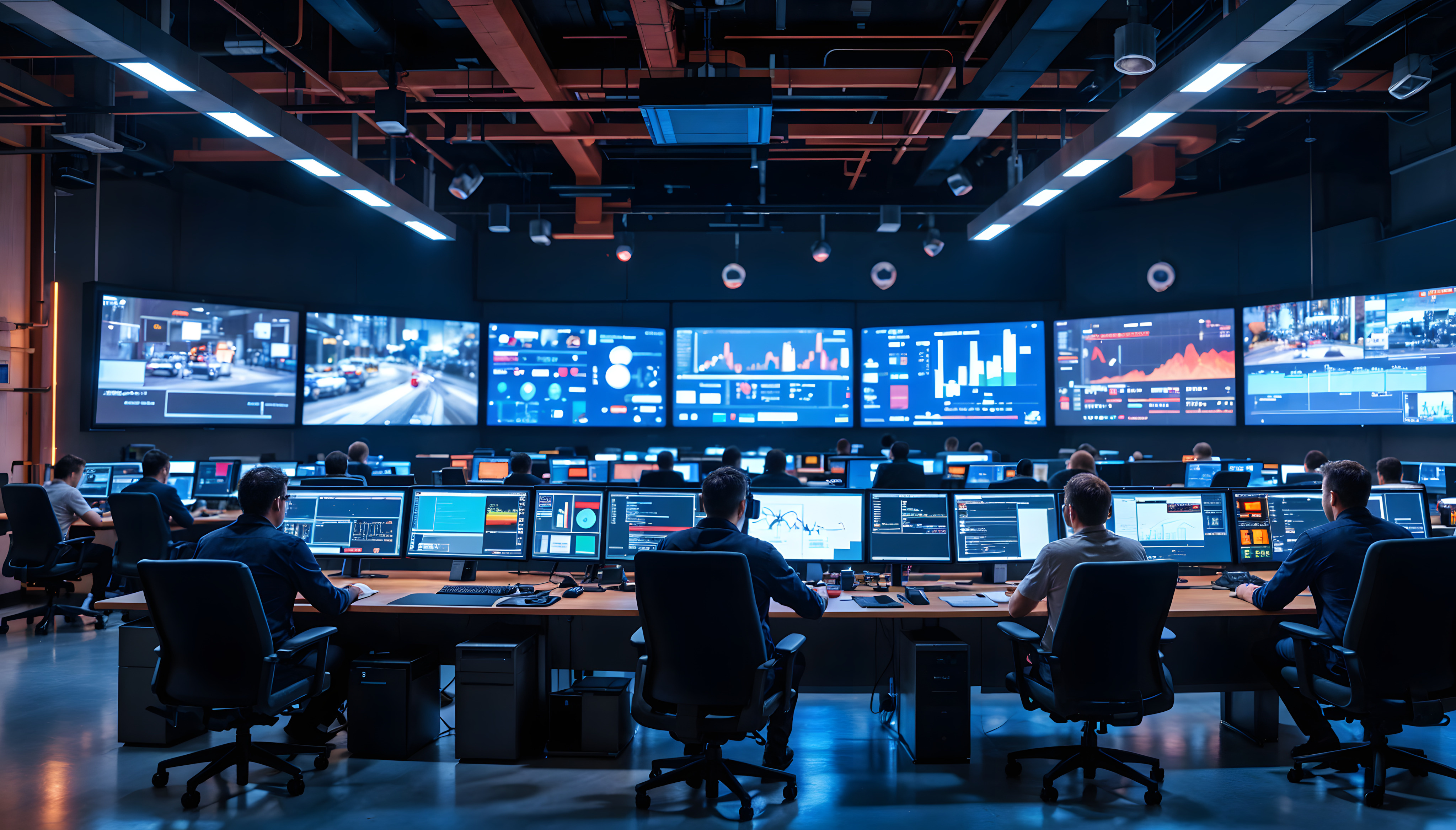
A command center should do more than display information. It should help operators see the trend, understand the risk, and respond before an event becomes a crisis.
In high-consequence environments, visibility is not measured by the number of screens in a room. It is measured by how quickly an operator can understand what is happening, where it is happening, and what needs to happen next.
For organizations responsible for petrochemical operations, oil and gas assets, public safety, transportation networks, higher education campuses, or enterprise security, the command center environment directly affects response time, operator accuracy, and mission continuity.
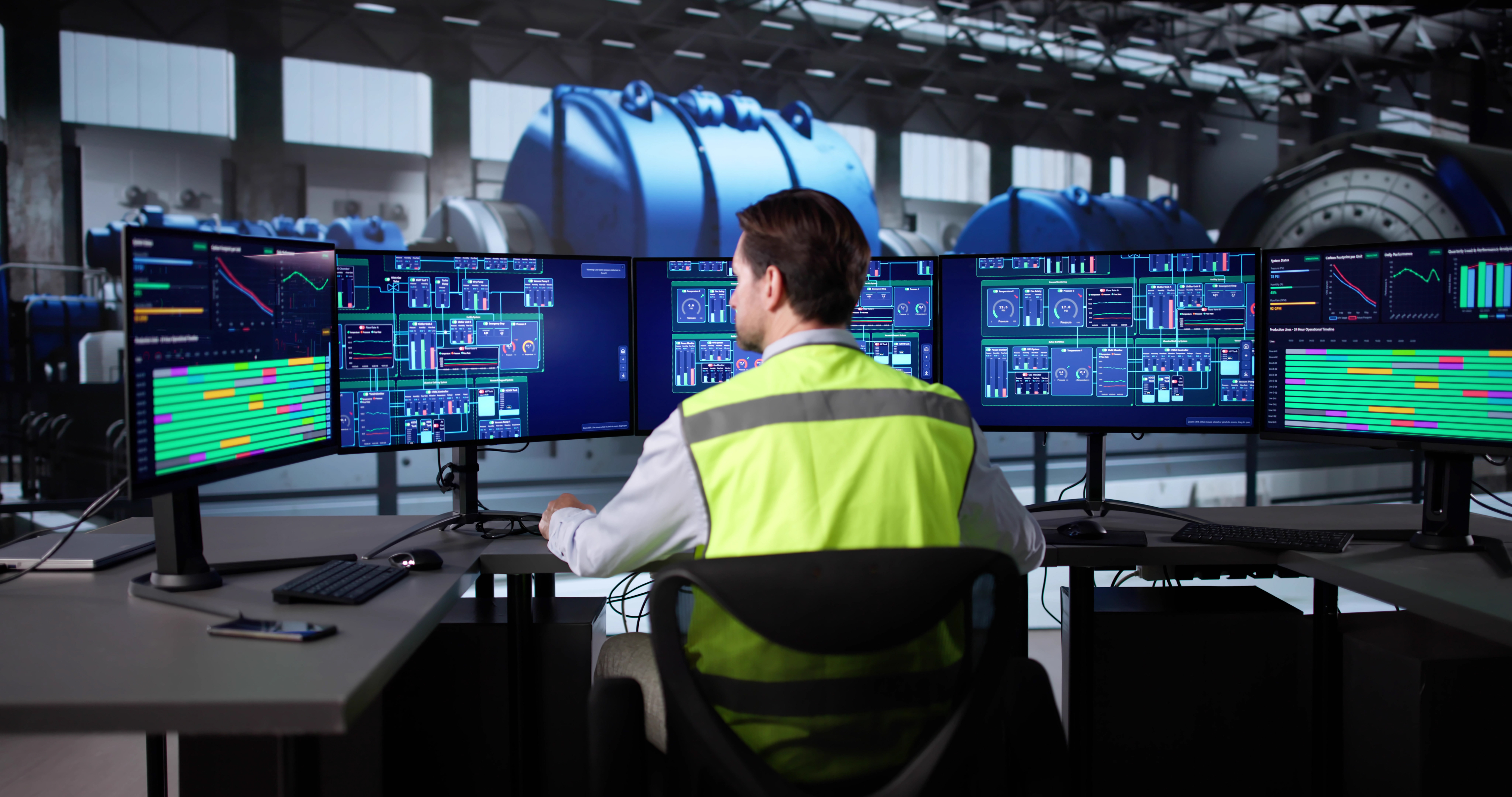
What is enhanced visibility in a command center? Enhanced visibility is the ability to unify alarms, video, maps, sensors, field communications, and operational data into a single Common Operating Picture so operators can detect events, understand context, and respond faster.
“I’m not thinking about pixels or brands. I’m thinking about the person in the chair at 3:00 AM. In a command center, visibility is your only weapon against chaos.”
— Earl Carter, Tru-Connect SME
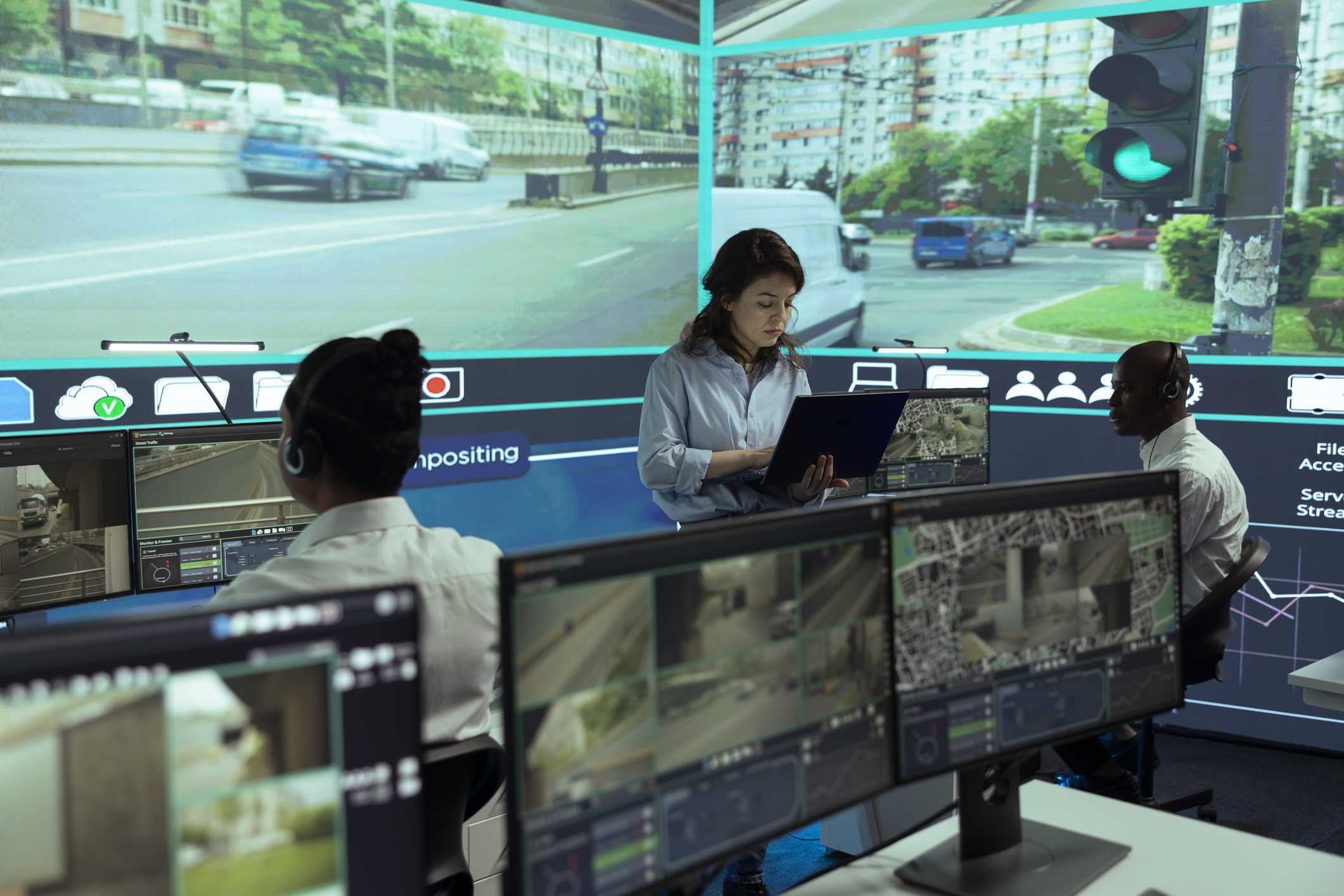
The Visibility Mandate
A command center does not just house technology. It dictates the speed of the human brain.
In mission-critical spaces, the room is never neutral. It is either accelerating the operator’s response or actively obstructing it. Yet many organizations still treat command center design as a furniture, display, or audiovisual procurement exercise instead of a strategic operational decision.
When a command center is designed around hardware instead of human performance, operators are forced to compensate. They toggle between software platforms, search for camera feeds, manually connect alarms to physical locations, and work through glare, heat, noise, and physical strain across long shifts.
That is not enhanced visibility. That is operational friction.
Command Center Design Challenges: Fragmented Systems, Operator Fatigue, and Slow Response
Most command centers suffer from two connected failures: fragmented system logic and poor environmental design.
The first failure is information fragmentation. Critical data often lives across separate platforms, including video management systems, SCADA, GIS mapping, license plate recognition, access control, intrusion detection, and field communications. During an active event, the operator becomes the manual integration point, moving between windows, keyboards, dashboards, and camera views just to build a complete picture.
“When your systems don’t talk, the operator becomes the ‘integration point.’ They’re having to manually bridge the gap between five different screens just to see a single event. That’s not a workflow; it’s a recipe for human error when the clock is ticking.”
— Earl Carter, Tru-Connect SME
Every system switch creates a reset. Every manual cross-reference consumes seconds. In a high-consequence environment, those seconds matter.
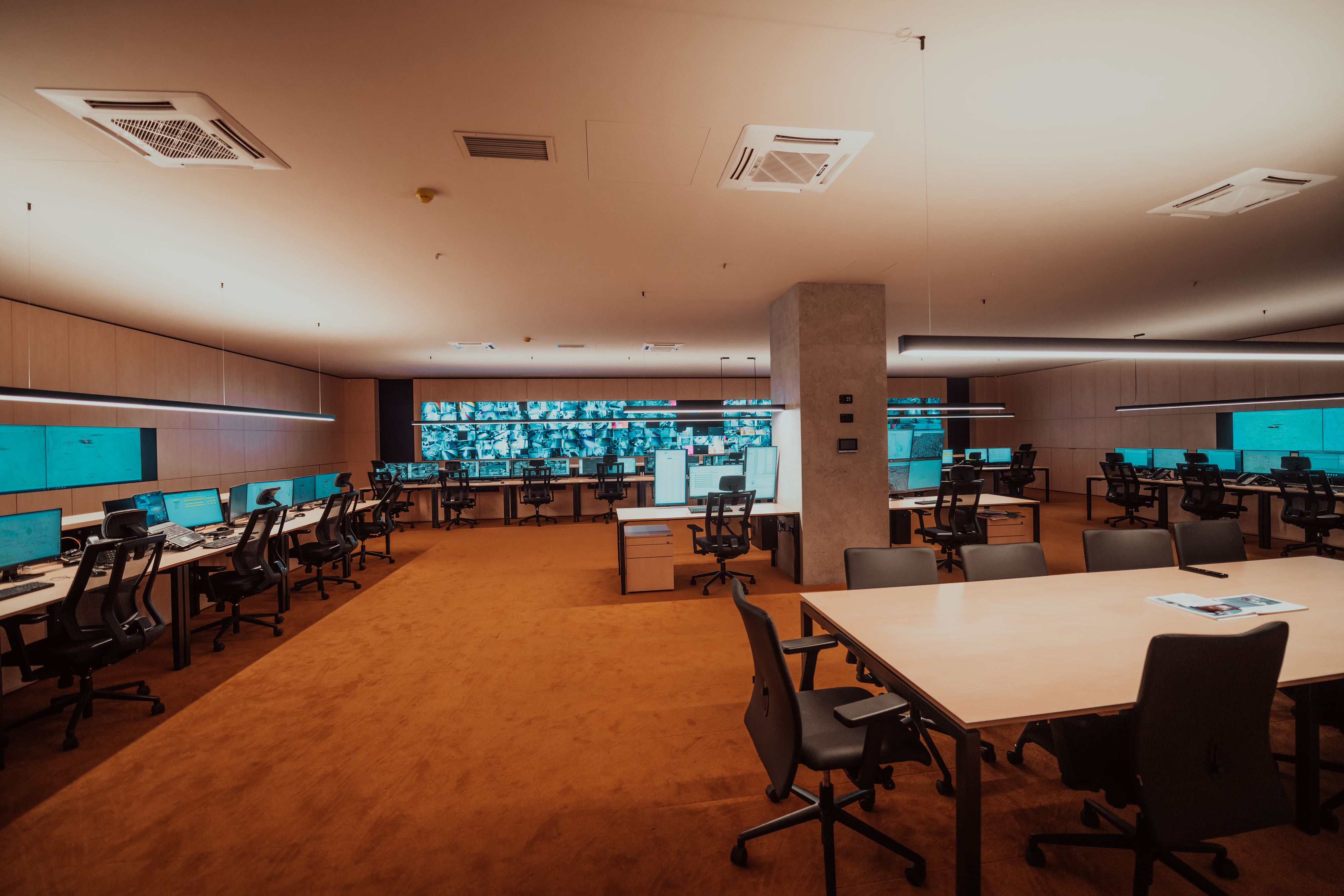
The second failure is poor room design. Standard audiovisual integrators often apply corporate boardroom logic to spaces that operate 24/7. They may mount displays and connect inputs, but overlook the physical realities of a mission-critical environment: sightlines, monitor placement, console geometry, lighting, acoustics, equipment heat, cable pathways, and operator fatigue.
By hour six of a 12-hour shift, those details matter. Desktop light wash, reflective surfaces, poorly positioned overview walls, noisy processors, and heat-heavy equipment can steadily drain an operator’s focus. By the time a high-stress incident occurs, the room may have already reduced the operator’s ability to respond clearly.
If your operators are switching between systems, manually matching alarms to camera feeds, or fighting the room itself, visibility is already compromised.
Designing Around the Operator, Not the Equipment
Tru-Connect’s “Blank Page” approach starts with the mission of the space before any technology is selected.
We define the operational risks, map the workflows, evaluate the room environment, and design around the person responsible for making decisions when seconds count. The goal is not to add more screens. The goal is to engineer a room where the right information becomes visible, contextual, and actionable.
Our process focuses on five priorities:
- Define the mission: Identify the operational heartbeat of the space, whether the priority is refinery monitoring, campus security, public safety coordination, airport operations, rail control, or enterprise awareness.
- Understand the operator: Evaluate what operators need to see, how quickly they need to act, which systems they use, and what physical conditions affect performance over time.
- Engineer the visual path: Optimize sightlines, monitor placement, console geometry, overview wall positioning, lighting, and surface finishes so critical data remains glanceable without neck strain or visual fatigue.
- Reduce decision load: Consolidate alarms, video, maps, sensors, and operational data into a unified Common Operating Picture.
- Design for scalability: Build on AV-over-IT, non-proprietary, peer-to-peer network architecture that supports redundancy, future expansion, new rooms, additional video walls, and integration of acquired systems without requiring a full rebuild.
This is where Tru-Connect’s approach differs from standard AV integration. We bring command center room design, human factors, secure network infrastructure, enterprise architecture, routing paths, cable planning, visualization systems, and commissioning together under one mission-led design-build process.
From Screens to Situational Awareness
Enhanced visibility is not created by adding more displays. It is created by removing the barriers between data and action.
A unified visualization environment allows operators to view the root cause and the downstream effect from a single operational interface. A pressure trend, camera feed, map layer, access control alert, or field communication does not have to sit in isolation. It can become part of one Common Operating Picture that helps teams recognize patterns faster and coordinate with greater confidence.
That shift reduces decision load. Operators no longer have to move between disconnected systems to understand one event. They can identify what is happening, connect related data points, and escalate the right information to the right people faster.
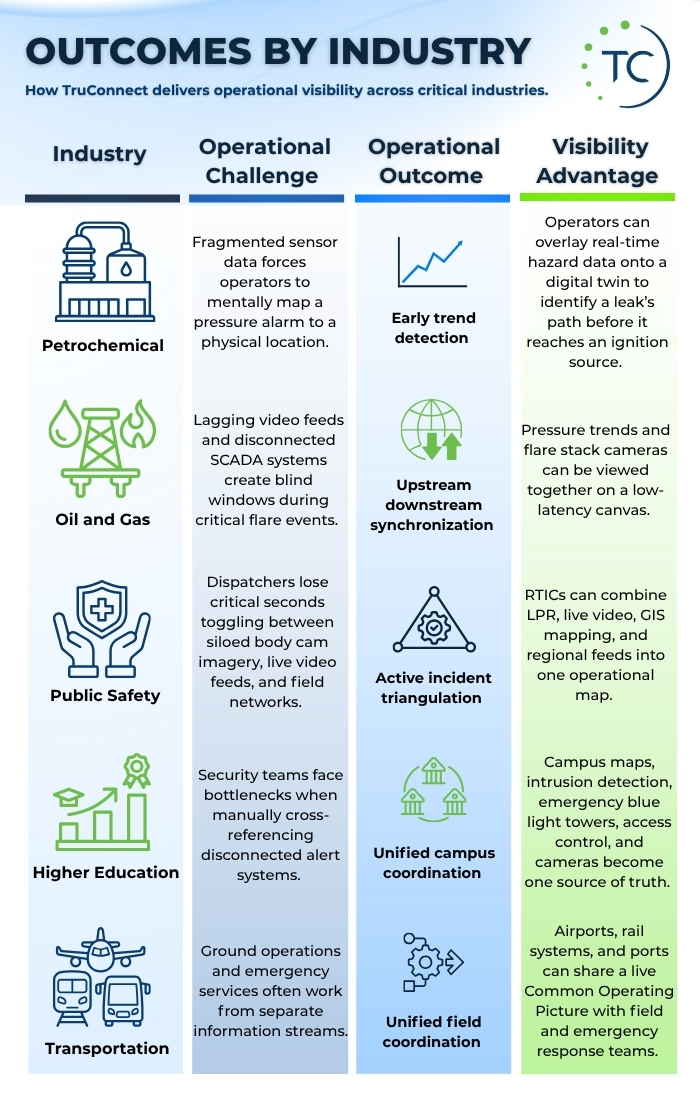
Outcomes by Industry
Enhanced visibility looks different by industry, but the goal is the same: faster awareness, clearer context, and more confident response.
Infrastructure Built for the Next Ten Years
A command center is a significant capital investment. It should be engineered as a long-term operational asset, not a room that becomes obsolete when systems change.
Tru-Connect protects that investment by prioritizing scalable, non-proprietary architecture. This helps organizations avoid the costly “scrap and rebuild” cycle caused by rigid, brand-locked systems.
That flexibility matters when organizations expand operations, add satellite facilities, build new rooms, integrate additional video walls, or inherit mismatched systems through mergers and acquisitions. A scalable AV-over-IT and visualization architecture makes it easier to absorb new technologies and unify them into one operational environment.
The room itself must also support long-term performance. Heat-heavy processors and video wall power supplies can be moved out of the operator environment and into dedicated IDF spaces. Acoustic loads can be reduced. Cable pathways can be planned for serviceability and growth. Lighting can be tuned to eliminate desktop light wash and preserve contrast.
These choices help operators stay sharp at hour eleven, not just hour one.
Take Control of the Mission
Is your command center built to support your operators, or is it wearing them down?
If your team depends on manual system switching, disconnected alerts, poor sightlines, excessive heat, glare, noise, or brand-locked infrastructure, visibility is already compromised.
Tru-Connect helps organizations move from equipment-led design to mission-led command center architecture, integrating room design, human factors, secure network infrastructure, visualization platforms, and scalable AV-over-IT systems into one operational environment.
Schedule a Blank Page Audit to identify where fragmented systems, poor sightlines, glare, heat, noise, or outdated AV infrastructure may be slowing your command center response.
Services Provided
- Mission-Critical Command Center Design
- Command and Control Center Integration
- Human Factors and Operator Environment Planning
- Human Factors and Operator Environment Planning
- Common Operating Picture Integration
- AV-over-IT Infrastructure
- Secure Network Infrastructure and Routing
- Video Wall and Visualization System Design
Take the Lead
Let Tru-Connect be your trusted source for your facility’s total security and advanced communications systems integration solutions.